
The Hidden Safety Net of Veterinary Vaccines

At Caring Hands, our primary goal in vaccinating your pets is to protect them from preventable, life-threatening diseases. However, there is a secondary, lesser-known medical and financial benefit to having vaccines administered by a veterinarian rather than purchasing them over the counter. When a vaccine is properly handled and administered in a clinical setting, reputable manufacturers will typically cover treatment costs in the rare event of a severe reaction.
cat vaccine 1

Why Clinical Vaccine Administration Matters

Immunizations are the cornerstone of preventative veterinary medicine. While our primary focus is always on creating customized vaccination plans tailored to your pet’s specific age, lifestyle, and risk factors, how those vaccines are administered is just as critical as the protection they provide.

The importance of veterinary-administered vaccines was highlighted by a recent case we managed here at our hospital in Billings, MT. We treated a patient experiencing a severe—albeit rare—reaction where the dog’s immune system began aggressively attacking its own red blood cells following a vaccination. Clinically, this is a life-threatening crisis requiring immediate, intensive medical intervention.

Treating a profound immune reaction of this nature is neither simple nor inexpensive. It requires hospitalization, specialized medications, and close monitoring. For this particular dog, the cost of emergency care quickly escalated into the thousands of dollars.

In veterinary medicine, we routinely see families faced with impossible choices when sudden, massive medical expenses arise. Without financial assistance, the owners of this dog were facing the very real, heartbreaking reality of economic euthanasia.

However, because the vaccine was administered by a veterinarian, properly recorded in the patient’s medical file, and sourced directly from a known, reputable supplier, we were able to intervene on the client’s behalf. We contacted the vaccine manufacturer, and after reviewing the clinical documentation, the company paid for the dog’s treatment. Their backing literally made the difference between losing that patient and sending a recovering dog back home to its family.

Not All Veterinary Vaccinations Are Equal

It is important to clarify that simply having a veterinarian administer the vaccine is only half the equation—the manufacturer’s guarantee relies entirely on exact medical documentation. I cannot speak for every clinic, but at Caring Hands, we meticulously document the brand, serial, and lot number of every single vaccine in your pet’s permanent file.

By contrast, veterinarians who administer vaccines at feed stores, or temporary pop-up clinics run out of other locations, typically do not maintain these comprehensive, long-term records. If you cannot immediately produce that exact documentation when a severe reaction occurs, the manufacturer will not cover the treatment.

dog vaccine 2

The Hidden Risks of Over-the-Counter Vaccines

It is not uncommon, especially out here in the Mountain West, for owners or breeders to purchase vaccines from a farm supply store or an online catalog. The motivation is usually to save a few dollars on routine care. However, simply picking up a syringe and poking your dog or cat with an over-the-counter vaccine carries significant, often unconsidered risks.

From a strictly medical standpoint, when vaccines are purchased outside of a veterinary clinic, the chain of custody is broken. You have no way to verify if the product was kept at the precise temperatures required during shipping and storage. An improperly stored vaccine is an ineffective vaccine, leaving your pet entirely unprotected against the diseases you are trying to prevent.
More importantly to your wallet, administering these vaccines at home almost always voids the manufacturer’s guarantee. If your dog or cat has a severe allergic reaction or an immune-mediated crisis, the vaccine company will not cover the cost of treatment. You will be entirely on your own. Attempting to save twenty dollars on a feed-store vaccine could ultimately cost you thousands of dollars in emergency veterinary care.

The True Value of a Clinical Vaccination

When you bring your pet into our hospital for immunizations, you are paying for much more than just the liquid in the vial—you are actively securing a medical safety net. A veterinary-administered vaccination provides several critical layers of protection:

Protecting Your Pet and Your Peace of Mind

At the end of the day, vaccinations remain one of the most effective tools we have in veterinary medicine to prevent devastating, highly contagious diseases. But how and where those vaccines are administered matters just as much as the vaccine itself.

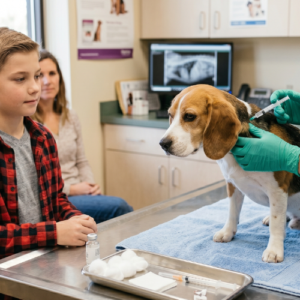
A young boy see's his pet beagle getting a shot.

By choosing to vaccinate your dog or cat in a clinical setting, you are doing more than just checking a box on their health record. You are ensuring that they are actually healthy enough to be vaccinated, that the biological product is viable, and that you have a powerful financial safety net in place should the unexpected occur.

As a veterinarian, my priority is keeping your pets healthy—and making sure you are fully supported when rare medical emergencies happen. Don't risk your pet's life or your financial stability on an unverified, over-the-counter vaccine.

Frequently Asked Questions

It is completely normal for a dog or cat to experience mild lethargy, a slight decrease in appetite, or a small, firm bump at the injection site for 24 to 48 hours after a vaccine. This is simply the immune system doing its job and responding to the antigen. These expected responses do not require medical intervention or manufacturer claims.

Severe reactions, while rare, require immediate veterinary attention. In practice, we look for acute signs of anaphylaxis such as facial swelling, hives, persistent vomiting, severe diarrhea, collapse, or difficulty breathing. In more complex cases—like the patient we recently treated—a reaction may trigger an ongoing immune-mediated crisis (such as the immune system attacking red blood cells or platelets) that develops over the days following the injection.

No. Manufacturer coverage is specifically designed for unexpected, severe adverse events that require documented clinical treatment. It does not cover the cost of a routine recheck for a slightly lethargic puppy. The coverage is there as a safety net for significant medical interventions, hospitalizations, and specialized treatments directly resulting from the vaccine.

This is where the clinical setting is invaluable. You do not have to fight with a pharmaceutical company on your own. If a severe reaction occurs, our hospital steps in. Because we have recorded the exact vaccine brand, serial number, and lot number in your pet’s official medical record, we can contact the manufacturer directly. We provide them with the clinical documentation and diagnostics, and they coordinate with us to cover the authorized treatment costs.

Do not wait to see if it resolves on its own. If you notice facial swelling, hives, difficulty breathing, or profound lethargy, call our clinic or an emergency veterinary hospital immediately. Time is critical in managing severe allergic or immune responses.

Is Your Pet Due for Their Wellness Exam and Vaccines?

If it is time to update your pet’s immunizations, or if you have questions about which specific vaccines are medically appropriate for their lifestyle here in Montana, our team is ready to assist you.

Call Our Caring Team

We're here to answer your vaccine-related questions and help you schedule care.

Book Online Anytime

Whether it's a vaccination, a recheck, or general advice, we’ve made booking simple.

About the Author

Dr. Amber Herron, DVM

Dr. Amber Herron, DVM

Dr. Amber Herron, DVM is the owner and lead veterinarian at Caring Hands Veterinary Hospital in Billings, Montana. She has practiced veterinary medicine in the Billings area since 2006 and became owner of the clinic in 2018. A Kansas State University graduate, Dr. Herron earned her Doctorate in Veterinary Medicine after completing a degree in microbiology. She provides care for a wide range of small animals and enjoys working with everything from dogs and cats to birds, pocket pets, and reptiles. Outside the clinic, she spends time with her husband Jim and their two children and is involved in responsible Bulldog breeding.