
Let’s Talk Cats and Travel: Making Car Trips Less of a Rollercoaster

Dr. Erika Cantamessa, DVM at Caring Hands Veterinary Hospital in Billings, is back with Part 2 of our feline travel series. Now that your cat accepts their carrier as a safe space, learn practical, step-by-step advice for lifting and moving it without causing panic—ensuring the journey to the car is just as stress-free as the destination.
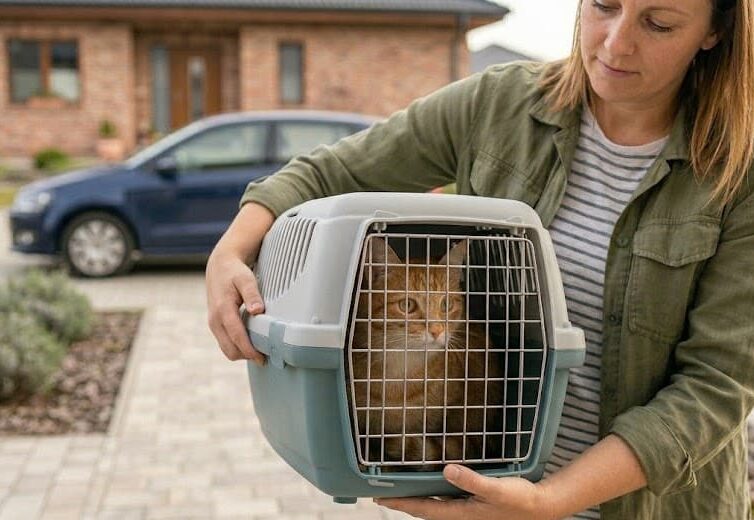
An owner safely transporting an orange tabby cat in a pet carrier outdoors, supporting the weight by holding the crate firmly from the bottom instead of using a top handle.

Welcome back. In Part 1 of our Cat Travel series, we focused on turning your cat’s carrier into a cozy piece of home furniture. Now that your cat is okay with the carrier existing in their environment and going inside, it is time to move on to being okay with the carrier moving around with them inside.

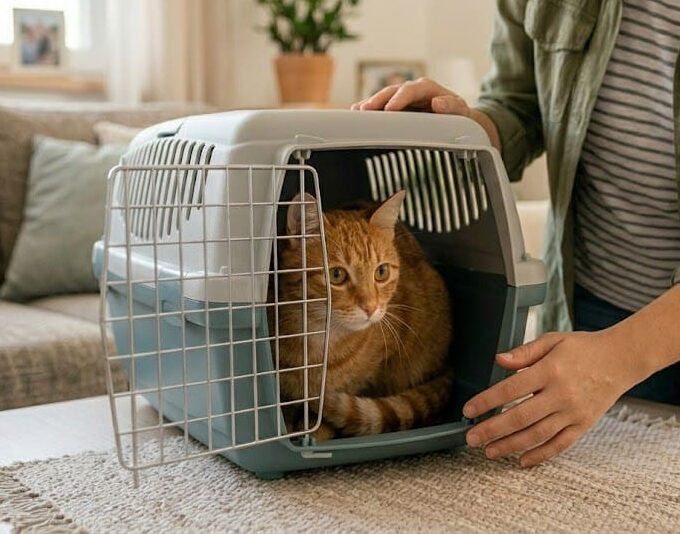
An orange tabby cat sitting calmly inside a light blue pet carrier with the metal door open, resting on a table in a living room.

Previously on Let’s Talk Cats...

In our previous article, we discussed how to get your cat used to the carrier by using positive reinforcement. Before moving on to motion, your cat should be completely comfortable with the groundwork we laid out:
The First Four Phases of Cat Carrier Comfort

If your kitty isn’t quite relaxed with a closed door yet, take a step back and review those phases before diving into today’s lesson!

The Carnival Ride

Before we continue, I want you to think back to the first time you went on a carnival ride. Were you scared, excited? Was it a positive experience? Did you get off and run right back in line to do it again, or did you run to the bushes to evacuate your most recent meal? Did you go on the ride voluntarily or did a friend or family member force you onto the ride? How did that make you feel about ever doing the ride again?

I imagine this is often how our cats feel about car rides. Once they are in the carrier they lose all free will. Much like what happens when you are strapped into the seat of a carnival ride. No wonder so many of them panic.

Now think about how you would feel if every time you got on the carnival ride it let you out, not at the carnival, but in a doctor’s office. Now how do you feel about your favorite carnival ride?

Okay, let’s talk about how to make carnivals… I mean car rides less scary.

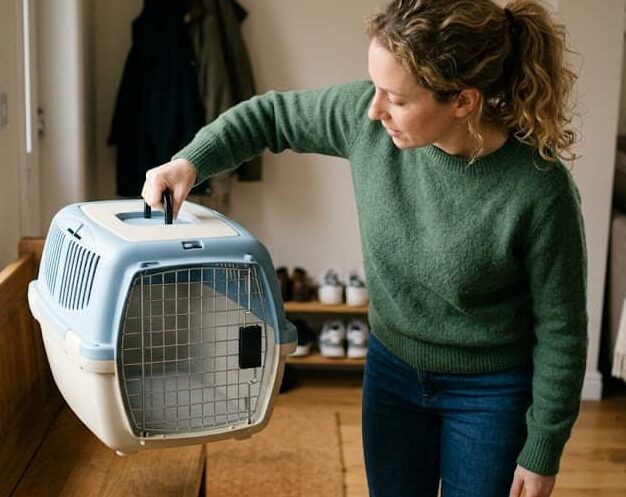
A woman in a green sweater and blue jeans lifts an empty, light blue and white plastic cat carrier by its top handle off a wooden bench. The scene takes place indoors in a well-lit entryway, with a window to the left and a shoe rack and sofa visible in the background.

Preparing for Liftoff

Our next step for making cat travel comfortable is working on getting the carrier to the car.

Think about lifting the carrier from your cat’s point of view. Many carriers come with handles on the top. When you lift the carrier by the handle what does it do? Is it still or does it start swinging from side to side? Ever been on the Ferris Wheel? Do you prefer it when it moves smoothly or when the seat really starts rocking? Your cat probably feels more secure if the carrier is not swinging all around.
I am going to suggest only using the handle to move the empty carrier. When your kitty is inside, think about treating her like the precious cargo she is and lift from the bottom. Your cat will thank you for the more stable motion of the carrier. It will likely make her less nauseous as well.

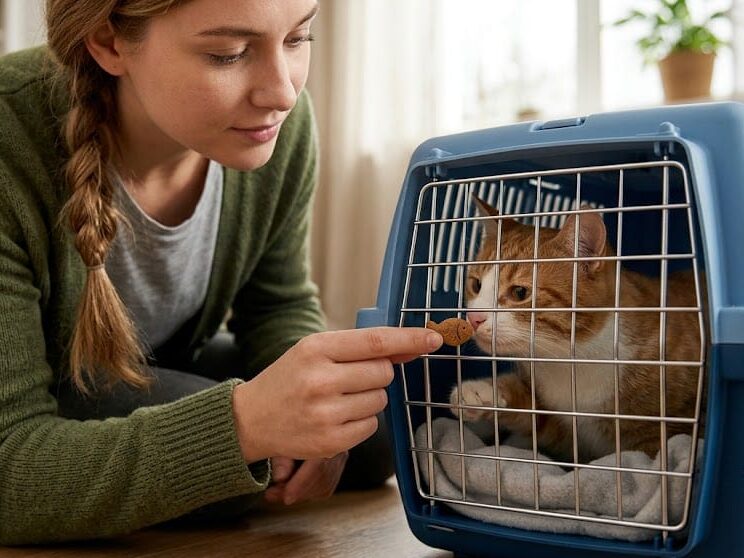
A young woman with blonde braided hair, wearing a green cardigan, sits on the floor facing a blue plastic cat carrier. She is holding a small, fish-shaped treat and offering it through the closed metal wire door of the carrier. Inside, an orange and white tabby cat is looking at the treat, with one paw resting on the inside of the wire grate. The setting is a cozy, softly lit living room.

Phase 5: Introducing Elevation

Start the session by asking your cat to enter the carrier. Maybe you do this by tossing a toy inside. Maybe you sit down next to the carrier with a bunch of treats and toss a few inside. Practice a couple of times with having your cat go inside, treat, close the door for a few seconds, treat, open the door and let your cat out, treat.
The next time you have your cat in the carrier with the door closed, lift the carrier a few inches, set it back down and give your cat a treat through the door. If they won’t take the treat, open the door and let them come out and give a treat. Practice at this level until your cat will repeatedly take a treat after the carrier was picked up and set down.

The steps from here are to increase the height you are lifting the carrier until your cat is okay having the carrier lifted to a comfortable carrying height. This should look like you standing up with the carrier held at hip height in your arms (remember NO HANDLES).

Remember to take breaks. Work in short sessions. After 5 repeats of lifting and lowering the carrier, open the door and let your cat leave if she wants. Wait 5 or 10 minutes (or continue on another day) and then invite your cat back into the carrier. If she enters, then she is consenting to another session.

A person carrying an orange cat in a pet carrier outdoors, supporting it firmly from the sides and bottom instead of using the top handle, with a car visible in the background.

Phase 6: Moving the Carrier

At this point you are ready to move. Start the next session with a couple repetitions of picking up and setting down. If your cat is still doing well and not panicking or yowling or scratching to be released and still wants treats, move on. The next time you pick up the carrier take one or two steps and set the carrier down and give a treat.

I’m hoping by now you get the idea. At your cat’s pace, build up to carrying the carrier around the room, into another room, outside, and finally placing the carrier in the car.

Remember this process could take minutes, hours, days, or weeks. The goal is a quiet, relaxed cat that still wants treats through the carrier door, and does not bolt when you finally release her from the carrier. You may need to take breaks to let her out for a few minutes and then continue when she is ready to get back inside. DON’T RUSH. Moving too fast (literally and figuratively, walk at a steady pace) can cause setbacks where your cat stops liking the carrier at all.

Troubleshooting Common Movement Problems

Start by going back to just picking up the carrier and setting it down. Stay on this step for 2 or 3 sessions on separate days. Once you are confident your cat is comfortable being lifted up and put down, start to increase the length of time you hold her in the air. Start with 30 seconds, then 1 minute, and build up to 5 minutes.

You might have a friend help and offer treats while you stand still holding the carrier. After a couple of sessions where you lift the carrier, hold for 5 minutes and set it down 3 to 5 times and your cat remains comfortable, try movement again.

This time, instead of taking a few steps and setting her down, try having someone feed treats at each ‘stop,’ so you don’t have to set the carrier all the way on the floor.

Is your cat a strictly indoor cat? The smells and feel of the outdoor air may be overwhelming. Consider using a pheromone spray on a towel or the bedding in the carrier 20 to 30 minutes prior to working with your cat. You could also consider practicing walking outside and right back inside and giving a treat.

Next Stop: The Great Outdoors (In the Car!)

Have you successfully made it to the car? Take your time. Just getting to the driveway is a massive milestone! Actually traveling in a moving vehicle is a whole different project. Watch for another article that will go over this important next step.

At Caring Hands Veterinary Hospital in Billings, we want to ensure your cat’s journey to see us is as stress-free as the veterinary care they receive once they arrive. Pet travel is a frequent topic brought up in our clinic, and we are always happy to help. Happy training, and we’ll see you for the next phase!

Call Our Caring Team

We're here to answer all of your pet travel questions and help you schedule care.

Book Online Anytime

Whether it's a pre-travel checkup or just general advice, we’ve made booking simple.

About the Author

Dr. Erika Cantamessa

Dr. Erika Cantamessa, DVM

Dr. Erika Cantamessa, DVM has been part of the Caring Hands Veterinary Hospital team since 2014. She enjoys helping pet owners better understand their animals’ health and believes education is an important part of good veterinary care. Outside the clinic, Dr. Cantamessa enjoys crafting, needlework, and spending time with her family. Her household currently includes a Golden Retriever named Bob and two cats, Luna and July. She is a native of Wallace, Idaho, and did her undergraduate work at Hamline University in St. Paul, MN. She received her DVM from Washington State University College of Veterinary Medicine in Pullman, WA.